Interiors
When Wood Becomes a Work of Art
Wood flooring goes beyond traditional parquet
Nov 24, 2025
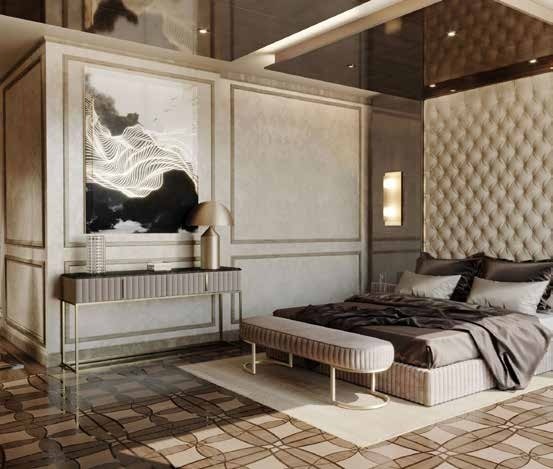
There is a moment when wood stops being just a floor or a surface and starts becoming something else entirely. Not decoration, not cladding, not even design — but a form of applied art. In these advanced wood works, timber is combined with marble and metal to create complex architectural compositions that go far beyond traditional parquet.
These are not floors. They are constructed surfaces. Designed, engineered, and handcrafted as one would approach a sculpture.
Where Wood Meets Stone and Metal
In these creations, wood is not used simply for its warmth or texture. It becomes a structural and visual backbone for the integration of other noble materials.
Natural stone and marble introduce density, history, and geological depth. Metal — whether brass, bronze, or stainless steel — brings precision, light, and contrast. Each material speaks a different language. The challenge is not just aesthetic, but physical: these materials expand, contract, react to humidity, temperature, and time in different ways.
The real complexity lies exactly there — in making them coexist.
A wooden surface breathes. Marble is rigid and stable. Metal conducts temperature and reacts to the surrounding climate. Once installed, they are no longer separate elements: they become a single system. If this system is not perfectly balanced in design, engineering, and execution, time will reveal every mistake.
This is why these works require not only artistic vision, but deep technical knowledge of material behavior.
The Role of Extreme Craftsmanship
This level of work cannot be improvised.
The wood must be carefully selected, cut, and stabilized. Every essence reacts differently: oak, walnut, maple, teak — each has its own movement, density, and response to environmental conditions. The stone elements must be precisely cut and adapted to micro-tolerances. The metal inlays often need both structural and decorative consideration, ensuring stability while maintaining visual perfection.
These are not standard operations. They require decades of practice. True mastery in this field is built over time, through accumulated experience, problem-solving, and an intimate understanding of materials that can only come from years spent in workshops, on construction sites, and through continuous experimentation.
This is an ancient art, rooted in historical intarsia, marquetry, and decorative stone flooring traditions — updated with modern technologies but still fundamentally dependent on human skill.


Wooden Surfaces as Architectural Elements
These creations are not accessories. They become architectural structures: monumental floors, wall panels, custom ceilings, decorative portals, or integrated furniture systems.
The surfaces are often built from modular compositions: individual pieces assembled into larger patterns, inspired by classical geometry, sacred symmetry, or contemporary abstraction. Floral motifs, rosettes, and interlocking geometries blend tradition with modern design language.
Each module must be designed to live within the space, not just occupy it. Light reflection, viewing angles, spatial proportions — everything is studied. The final effect is not static. It changes with time of day, with natural and artificial light, with how people move through the room.
A Discipline of Patience and Precision
What defines this craft more than anything else is time.
Time to design.
Time to test.
Time to cut.
Time to assemble.
Time to correct.
And above all, time to learn.
Mastering these techniques is not a matter of years. It often takes a lifetime. The most skilled artisans are those who have developed both their eye and their hands over decades, refining not only technique, but judgment — knowing how materials will behave not today, but ten, twenty, fifty years from now.
This is what separates a decorative surface from a lasting work of craftsmanship.
A Contemporary Role for an Ancient Art
In an era dominated by speed, replication, and synthetic materials, these works represent the opposite. They are slow. They are deliberate. They are permanent.
They bring back into architecture something increasingly rare: the presence of human intelligence embedded in matter.
When wood, marble, and metal are combined at this level, they do not just coexist. They form a living structure — one that carries knowledge, tradition, and the silent signature of those who shaped it by hand.
And that is why these surfaces are not simply designed.
They are mastered.
Let's
create
something
timeless
Whether you have a vision in mind or are just exploring, our team is here to bring beauty, purpose, and elegance to your space.